![[personal profile]](https://www.dreamwidth.org/img/silk/identity/user.png) teratornis
teratornisRunaway to the Stars is a long-term graphic novel project that I've been following for a number of years now. In light of its recently-launched (and already successful!) Kickstarter campaign for PDF and print formats of the comic, I thought I'd write a bit about this project.
This is going to get long, and contains images (all images are linked to the source, so they can be viewed embiggened in their natural habitat).
Runaway to the Stars is written and illustrated by Jay Eaton, a digital artist with a background in evolutionary biology. They started posting comic pages online a little less than three years ago, and spent a number of years before that drawing said pages, and building the setting and characters. The story is far-future hard sci-fi, with an immense amount of detail around the present technology and how it functions, as well as the biology and cultures of all the people involved, human and alien alike.
I started following Jay's work long before they started posting comic pages online. I'm a sucker for worldbuilding, and especially for speculative biology, and the work behind this comic hits all of those buttons for me. The amount of work Jay has done on establishing so many details of the setting is absolutely incredible, and I at least never get tired of learning about the details.
RttS features six different sapient races, five of which are biological, one of which is artificial. For each one there's extensive information on their home planet (climate, geography, environments, flora and fauna, even plate tectonics in some cases), physical biology (skeletal structure, organ configuration and function, diet, species variants, reproduction, even the spectrum of light they can see), and culture (societal setup, family configuration, politics and hierarchy, religion, traditions and taboos, fashion, languages).
There's information on the technology, on how ships and habitats work in space, on how a launch and long-term space travel work, on how gravity and food and air and water is managed. How tools used to repair or break down or maintain a ship or a habitat work, some of the safety procedures involved, and how tech from different species and cultures interacts (or, sometimes, doesn't interact, as the case may be).
Given that Jay is as much an artist as a worldbuilder and storyteller, there's images and diagrams and sometimes animations and comics to go along with all of this.
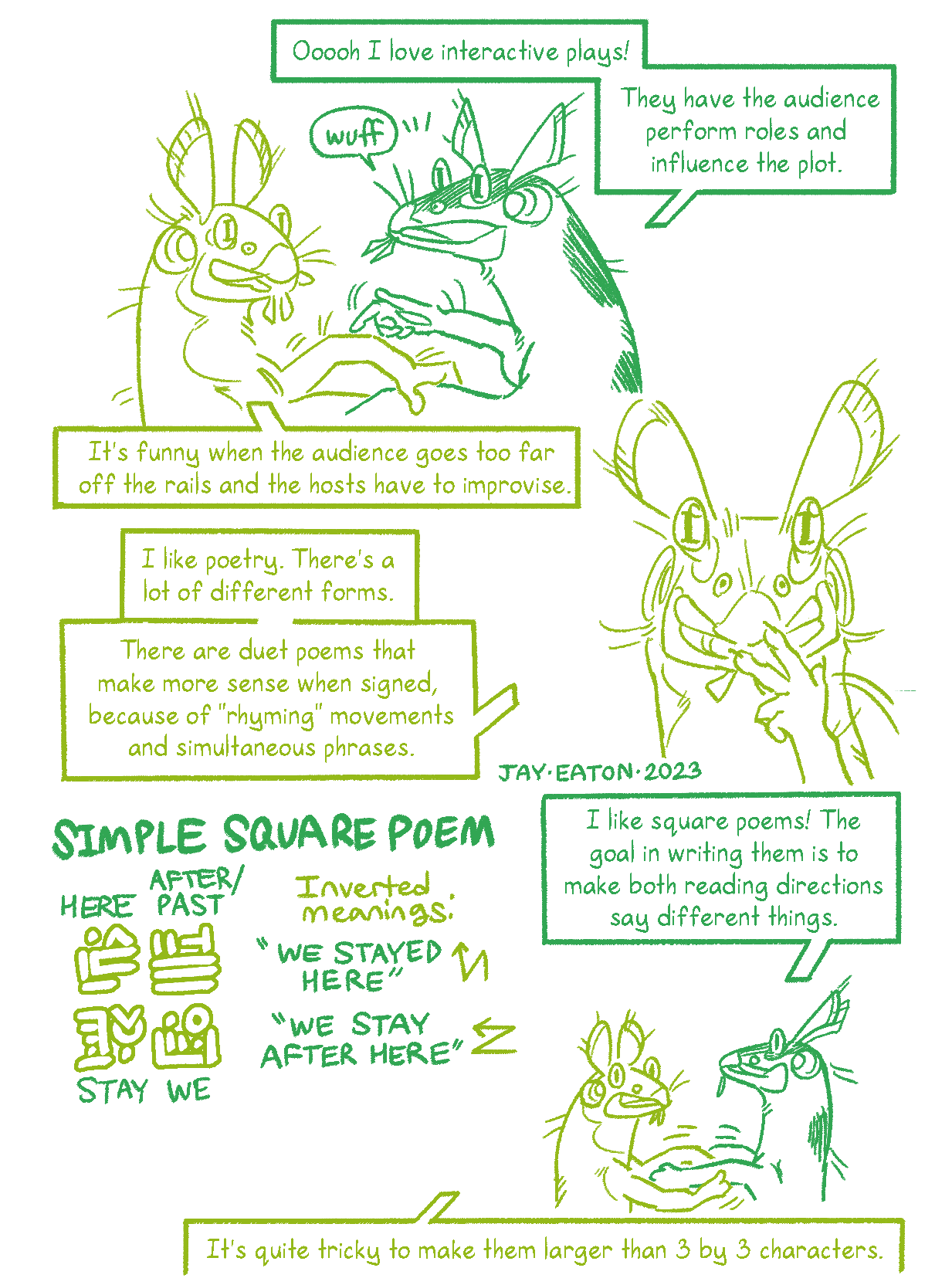
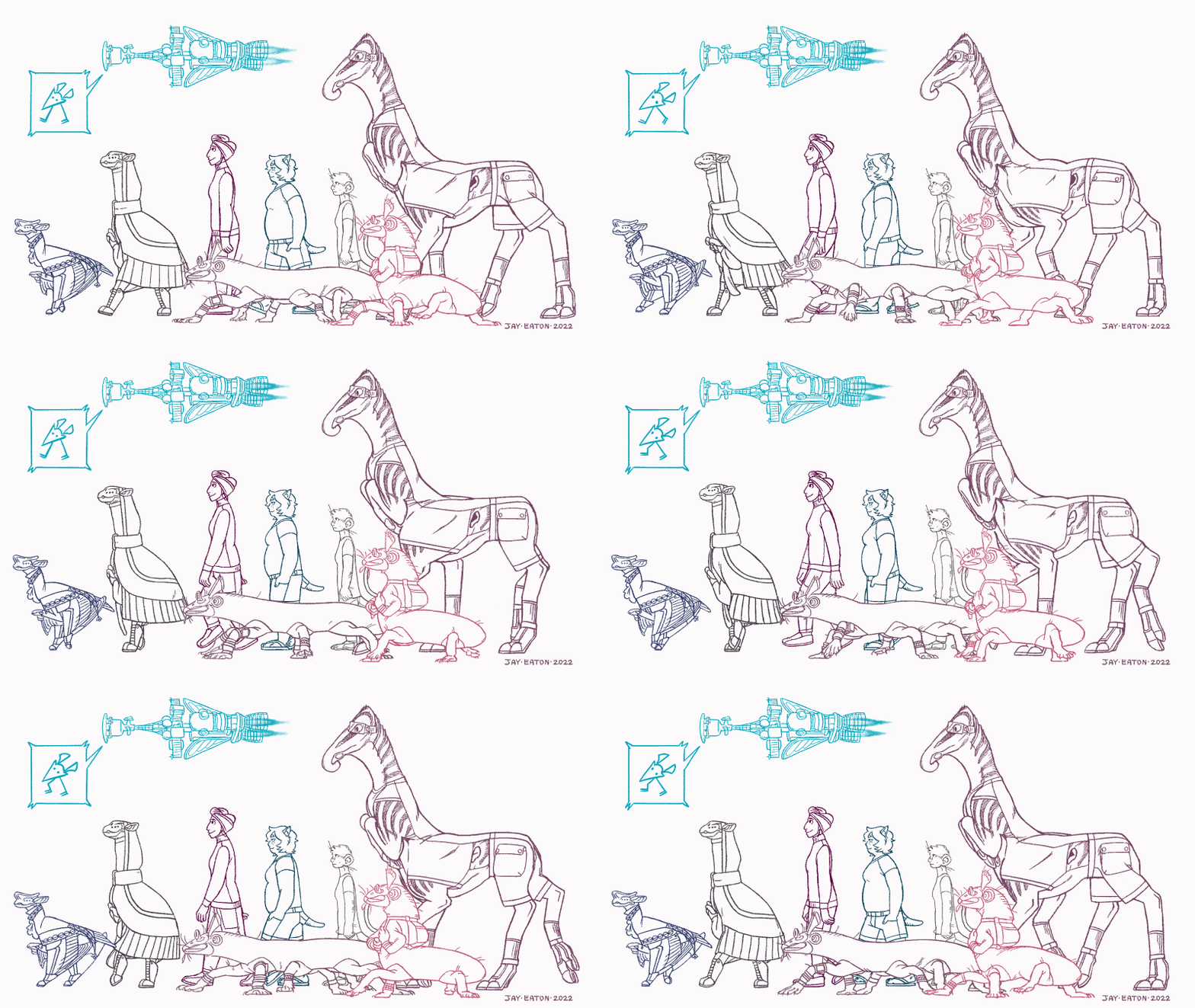


Okay I got sidetracked at this point digging through all of the cool background information and side stories for RttS and lost like two hours, but anyway.
So the interesting thing, though, is that despite the truly immense amount of worldbuilding, the years and years that went into putting this setting and these characters together, on establishing the technology and the culture and all the rest, at its core RttS is a slice-of-life story.
Admittedly it's a slice-of-life story that takes place at a mining colony-turned-junkyard on a planet with no natural atmosphere, and the main character is a 10-foot-tall centaur alien who was raised in human foster care.
What impresses me consistently about RttS, given all of this, is that all that background worldbuilding, while certainly important to the setting, is not necessary to enjoy the story. The story is very solidly driven by the characters, by their relationships, their anxieties and fears, and how they respond to unexpected situations. Admittedly my perspective is likely skewed, given how long I've been following all the background stuff before the comic even began, but the characters and their struggles stand so solidly all on their own, without having the kind of background I've steeped myself in.
What all that worldbuilding does, though, is make the whole setting feel phenomenally, incredibly alive in a way I don't often see. The sheer level of detail all that work allows Jay to include in, frankly, ever single page of RttS makes the whole experience so wonderfully rich. There are so many tiny aspects and details all over the place that are fun to look for, fun to spot, and make the world work in some really fascinating ways. The way all that worldbuilding informs the characters' experiences and interactions lends a great deal of depth to everything.
The main character, Talita, is a member of a species known as the centaur aliens. They are hypercarnivorous pursuit predators, evolutionarily speaking, whose society is largely made of of matriarchal clans. Talita, however, was raised among humans, attended human schools, and has only rarely encountered other centaurs at all. She's never once been to their home planet.
This shows up all the time in the art. It shows up in Talita's nervousness, in the ticks that she has, in the human behaviors she's adopted paired with her own natural responses to things. Jay has paid an astonishing amount of attention to body language, and to making that body language both alien, and yet recognizable to the readers as both human-inspired, and also easily readable to convey Talita's mood.
The characters finding a way to navigate their world is a big theme in this story. Idrisah, another main character, is a practicing Muslim. She struggles consistently with how to maintain family ties, and how best to express her faith while living and working so, so far from home. Her wife Gillie is genetically modified to possess cat-like features, but was born what is referred to in-universe as 'off-model'. Her features aren't what was expected or desired, and make her uncomfortable to display. She hides her ears and tail in public, and plucks her whiskers to appear more like a typical human.
She's also deaf, as a result of these modifications. Her struggles to communicate also come up repeatedly, and an ongoing sub-plot is Gillie and Talita working out the best way to communicate with each other. Talita's experience being raised among humans has left her uncomfortable with her own body, and in this case specifically her four-fingered hands, and the difficulties that causes her in learning ASL. Her reluctance to learn causes Gillie a great deal of distress, and makes her feel rejected by a friend.
Fortunately, they work it out.

(One of the things many, many artists struggle with drawing is hands. Drawing hands in dynamic poses, especially. Drawing a whole page of both human and alien hands spelling out the entire alphabet in ASL is an absolutely bonkers undertaking. And very in line with the sheer level of detail this comic contains.)
The remaining member of the main cast is Bip, the artificial intelligence pilot inhabiting a damaged and deserted ship Talita encounters at the beginning of the story (the titular Runaway). Bip is loud and sarcastic and bad at boundaries and something of a jokester. They've also just lost their entire crew, a full clan of centaurs.
One of the most emotional parts of the comic so far, where all those worldbuilding and cultural details come together to have a heavy impact on the characters, is when Talita finds a blanket that belonged to Bip's crew, made of tanned velvet from the antlers all centaurs grow every year, that serves as a historical record of the clan.


On a purely technical level, RttS is a truly impressive piece of work. I've spent some time studying comics and sequential art, and comics are an intensely difficult medium to do well. You have to manage image composition multiple times a page, for hundreds of pages. You have to frame the art in a way that viewers will be able to track character movement and location, and the time frame of the comic. You have to leave room for text that doesn't interfere with your composition and art. You have to make sure that text is ordered in a way that you know who's saying what, and which bit of dialogue comes first. The frames must proceed in a way that make their order clear, and show a logical progression of actions and speech. You have to be very good at telling a story using both visuals and text.
RttS is, frankly, a master class in all of these things. Additionally, Jay is a truly phenomenal artist. The kind of consistency and detail they achieve would be impressive under any circumstances. That they're routinely handling alien anatomy and locations makes it even more so. There's no real reference to be had for a lot of what they're drawing. It's hard to work with no real reference, or to have to patchwork your reference together from multiple sources, and then figure the rest out for yourself. I can only speculate at how helpful all that worldbuilding is when actually drawing comic pages.
The whole comic is, frankly, gorgeous. Top-notch art, wonderful character design, absolutely incredible scene setting and level of detail. The story's interesting, the conflicts are genuine and emotional and, in many cases, deeply relatable. That it's a hard sci-fi setting on a different planet doesn't change the fact that the people involved are still fundamentally people, with all the conflicts and difficulties and struggles that entails.
I eagerly look forward to new pages of this comic every week, and I intend to follow it to the end, however many years that might take. I'm thrilled for Jay that the publishing Kickstarter has done so well already. This project very much deserves it, and I'll be very excited to see it in print someday. It's a story that is very much worth checking out.
This is going to get long, and contains images (all images are linked to the source, so they can be viewed embiggened in their natural habitat).
Runaway to the Stars is written and illustrated by Jay Eaton, a digital artist with a background in evolutionary biology. They started posting comic pages online a little less than three years ago, and spent a number of years before that drawing said pages, and building the setting and characters. The story is far-future hard sci-fi, with an immense amount of detail around the present technology and how it functions, as well as the biology and cultures of all the people involved, human and alien alike.
I started following Jay's work long before they started posting comic pages online. I'm a sucker for worldbuilding, and especially for speculative biology, and the work behind this comic hits all of those buttons for me. The amount of work Jay has done on establishing so many details of the setting is absolutely incredible, and I at least never get tired of learning about the details.
RttS features six different sapient races, five of which are biological, one of which is artificial. For each one there's extensive information on their home planet (climate, geography, environments, flora and fauna, even plate tectonics in some cases), physical biology (skeletal structure, organ configuration and function, diet, species variants, reproduction, even the spectrum of light they can see), and culture (societal setup, family configuration, politics and hierarchy, religion, traditions and taboos, fashion, languages).
There's information on the technology, on how ships and habitats work in space, on how a launch and long-term space travel work, on how gravity and food and air and water is managed. How tools used to repair or break down or maintain a ship or a habitat work, some of the safety procedures involved, and how tech from different species and cultures interacts (or, sometimes, doesn't interact, as the case may be).
Given that Jay is as much an artist as a worldbuilder and storyteller, there's images and diagrams and sometimes animations and comics to go along with all of this.
Okay I got sidetracked at this point digging through all of the cool background information and side stories for RttS and lost like two hours, but anyway.
So the interesting thing, though, is that despite the truly immense amount of worldbuilding, the years and years that went into putting this setting and these characters together, on establishing the technology and the culture and all the rest, at its core RttS is a slice-of-life story.
Admittedly it's a slice-of-life story that takes place at a mining colony-turned-junkyard on a planet with no natural atmosphere, and the main character is a 10-foot-tall centaur alien who was raised in human foster care.
What impresses me consistently about RttS, given all of this, is that all that background worldbuilding, while certainly important to the setting, is not necessary to enjoy the story. The story is very solidly driven by the characters, by their relationships, their anxieties and fears, and how they respond to unexpected situations. Admittedly my perspective is likely skewed, given how long I've been following all the background stuff before the comic even began, but the characters and their struggles stand so solidly all on their own, without having the kind of background I've steeped myself in.
What all that worldbuilding does, though, is make the whole setting feel phenomenally, incredibly alive in a way I don't often see. The sheer level of detail all that work allows Jay to include in, frankly, ever single page of RttS makes the whole experience so wonderfully rich. There are so many tiny aspects and details all over the place that are fun to look for, fun to spot, and make the world work in some really fascinating ways. The way all that worldbuilding informs the characters' experiences and interactions lends a great deal of depth to everything.
The main character, Talita, is a member of a species known as the centaur aliens. They are hypercarnivorous pursuit predators, evolutionarily speaking, whose society is largely made of of matriarchal clans. Talita, however, was raised among humans, attended human schools, and has only rarely encountered other centaurs at all. She's never once been to their home planet.
This shows up all the time in the art. It shows up in Talita's nervousness, in the ticks that she has, in the human behaviors she's adopted paired with her own natural responses to things. Jay has paid an astonishing amount of attention to body language, and to making that body language both alien, and yet recognizable to the readers as both human-inspired, and also easily readable to convey Talita's mood.
The characters finding a way to navigate their world is a big theme in this story. Idrisah, another main character, is a practicing Muslim. She struggles consistently with how to maintain family ties, and how best to express her faith while living and working so, so far from home. Her wife Gillie is genetically modified to possess cat-like features, but was born what is referred to in-universe as 'off-model'. Her features aren't what was expected or desired, and make her uncomfortable to display. She hides her ears and tail in public, and plucks her whiskers to appear more like a typical human.
She's also deaf, as a result of these modifications. Her struggles to communicate also come up repeatedly, and an ongoing sub-plot is Gillie and Talita working out the best way to communicate with each other. Talita's experience being raised among humans has left her uncomfortable with her own body, and in this case specifically her four-fingered hands, and the difficulties that causes her in learning ASL. Her reluctance to learn causes Gillie a great deal of distress, and makes her feel rejected by a friend.
Fortunately, they work it out.
(One of the things many, many artists struggle with drawing is hands. Drawing hands in dynamic poses, especially. Drawing a whole page of both human and alien hands spelling out the entire alphabet in ASL is an absolutely bonkers undertaking. And very in line with the sheer level of detail this comic contains.)
The remaining member of the main cast is Bip, the artificial intelligence pilot inhabiting a damaged and deserted ship Talita encounters at the beginning of the story (the titular Runaway). Bip is loud and sarcastic and bad at boundaries and something of a jokester. They've also just lost their entire crew, a full clan of centaurs.
One of the most emotional parts of the comic so far, where all those worldbuilding and cultural details come together to have a heavy impact on the characters, is when Talita finds a blanket that belonged to Bip's crew, made of tanned velvet from the antlers all centaurs grow every year, that serves as a historical record of the clan.
On a purely technical level, RttS is a truly impressive piece of work. I've spent some time studying comics and sequential art, and comics are an intensely difficult medium to do well. You have to manage image composition multiple times a page, for hundreds of pages. You have to frame the art in a way that viewers will be able to track character movement and location, and the time frame of the comic. You have to leave room for text that doesn't interfere with your composition and art. You have to make sure that text is ordered in a way that you know who's saying what, and which bit of dialogue comes first. The frames must proceed in a way that make their order clear, and show a logical progression of actions and speech. You have to be very good at telling a story using both visuals and text.
RttS is, frankly, a master class in all of these things. Additionally, Jay is a truly phenomenal artist. The kind of consistency and detail they achieve would be impressive under any circumstances. That they're routinely handling alien anatomy and locations makes it even more so. There's no real reference to be had for a lot of what they're drawing. It's hard to work with no real reference, or to have to patchwork your reference together from multiple sources, and then figure the rest out for yourself. I can only speculate at how helpful all that worldbuilding is when actually drawing comic pages.
The whole comic is, frankly, gorgeous. Top-notch art, wonderful character design, absolutely incredible scene setting and level of detail. The story's interesting, the conflicts are genuine and emotional and, in many cases, deeply relatable. That it's a hard sci-fi setting on a different planet doesn't change the fact that the people involved are still fundamentally people, with all the conflicts and difficulties and struggles that entails.
I eagerly look forward to new pages of this comic every week, and I intend to follow it to the end, however many years that might take. I'm thrilled for Jay that the publishing Kickstarter has done so well already. This project very much deserves it, and I'll be very excited to see it in print someday. It's a story that is very much worth checking out.